A look at the first four months of post-OBBB suppressor commerce
On January 1, 2026, the NFA transfer tax on suppressors dropped from $200 to $0. The change, a product of an ASA-led effort and enacted through the One Big Beautiful Bill Act (OBBB), is the most consequential shift in suppressor commerce since the National Firearms Act's enactment in 1934. Four months of ATF data have been published, and it tells a clear story: the market did not just spike. It reset to a higher level.
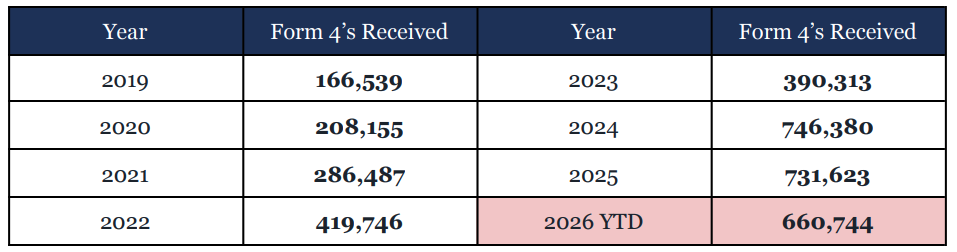
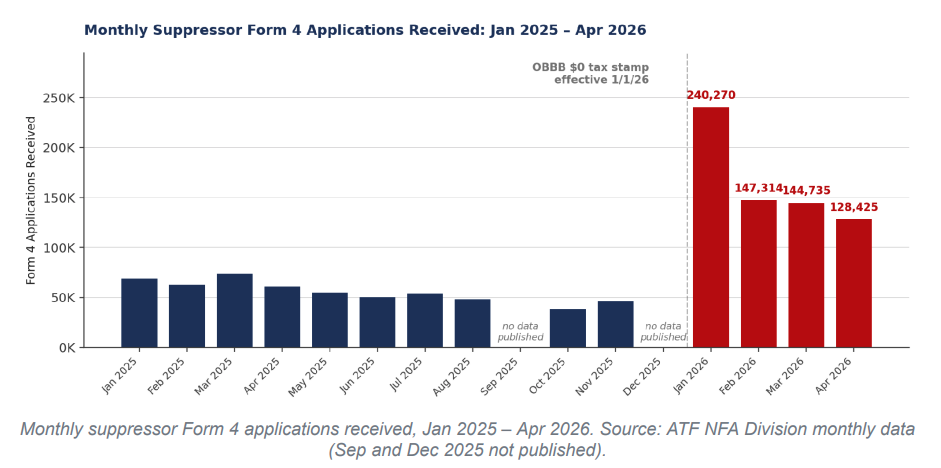
From January through April, consumers filed 660,744 suppressor Form 4 applications — equal to 90% of the entire 2025 total in just one-third of the year. January alone produced 240,270 applications, the single largest month in ASA’s dataset and more than the entire calendar year of 2019. Every month from February through April outpaced any individual month recorded across 2024 and 2025 following the dramatic reduction in transfer times. Based on a blended wholesale price of $635 per suppressor, the four-month surge represents roughly $419.6 million in wholesale value, already on pace to eclipse both 2024 ($458M) and 2025 ($449M) full-year totals if demand holds.
A new demand floor, not a one-time event
After OBBB was signed into law in July 2025, it became clear that many buyers would wait to purchase a suppressor until the new law took effect. While this pent-up demand explains part of the January surge, the months that followed are just as telling. While February through April were not as high as the January peak, each remained elevated well above the previous 2024-2025 monthly levels. They settled into a run-rate of roughly 140,000 applications per month — about two and a half times the monthly average in 2025.
That pattern points to a permanently higher demand floor rather than a temporary bubble. For context, demand leveled off near 62,000 suppressors per month through 2025; the post-OBBB market is operating at multiples of that level. April’s moderation to 128,425 may reflect natural normalization, manufacturing constraints, or both — and which of those it is will shape the rest of the year.
2026: Projected scenarios
With four months of data in hand, ASA has tightened its full-year outlook into three scenarios:
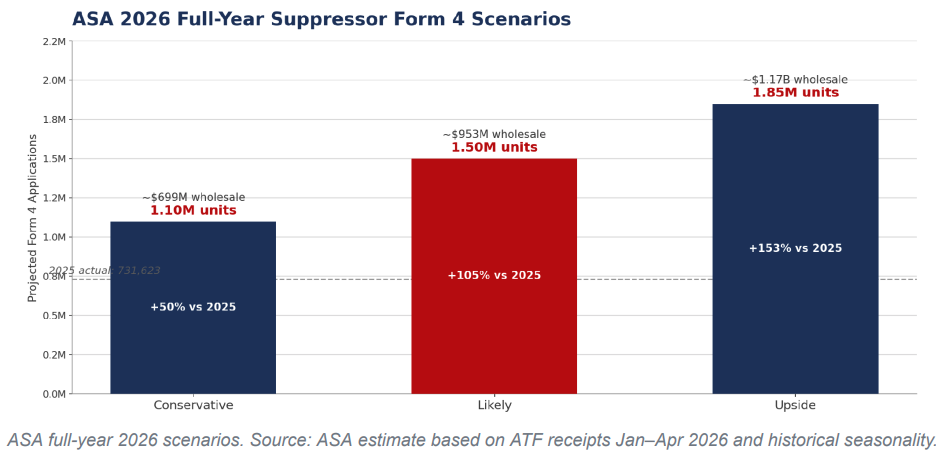
Conservative (~1.10M units, ~$699M wholesale): demand reverts to the 2025 baseline of roughly 55,000 per month from May onward.
Likely (~1.50M units, ~$953M wholesale): April’s run-rate holds as the new floor, with a mild Q4 seasonal lift — roughly double 2024–2025 volume.
Upside (~1.85M units, ~$1.17B wholesale): strong demand continues alongside a steady flow of new market entrants.
Manufacturing capacity constraint
Early in the 2024 surge, after ATF dramatically cut transfer times, the industry's manufacturing capacity topped out around 55,000 suppressors per month. Heading into 2026, manufacturers had a roughly six-month on-ramp to expand production and build inventory ahead of the January 1 effective date. Even so, manufacturers and distributors reported supply constraints in early 2026 reminiscent of spring 2024, with production capacity again becoming the limiting factor on near-term unit volume. The takeaway for the industry is straightforward: capacity, not consumer interest, is the limiting factor of Form 4 application volume. Manufacturers who invested in expanding production through 2025 are well-positioned to capture disproportionate market share as the new normal settles in.
ATF has kept pace
One of the more remarkable aspects of the surge is how well the ATF NFA Division handled it. During the same January–April window, ATF processed 607,797 suppressor Form 4 applications — within 8% of what it received — with February and March each clearing more applications than arrived as the post-January queue drew down. Median individual eForm 4 processing time held between 6 and 12 days throughout the period, despite roughly triple the historical monthly volume.
For an agency whose suppressor transfer times were measured in months or years for most of the past century — peaking near 232 days as recently as June 2023 — this is a striking performance improvement. The Division accomplished this turnaround in part by drawing on personnel detailed from outside its usual ranks, which is also a vulnerability worth watching: if that outside support is withdrawn while volume remains high, processing times could climb. However, current ATF leadership is cognizant of wait times and committed to minimizing their impact. In addition, ASA is working on additional regulatory changes to further streamline the transfer process.
A registry growing faster than ever
As of May 27, 2026, 6,139,745 suppressors were registered in the National Firearms Registration and Transfer Record (NFRTR) — an increase of more than 1.7 million since January 2025. Net additions reached roughly 805,595 in 2024 and about 1,357,107 in 2025, making the past 18 months the steepest registration acceleration in the history of the NFA.
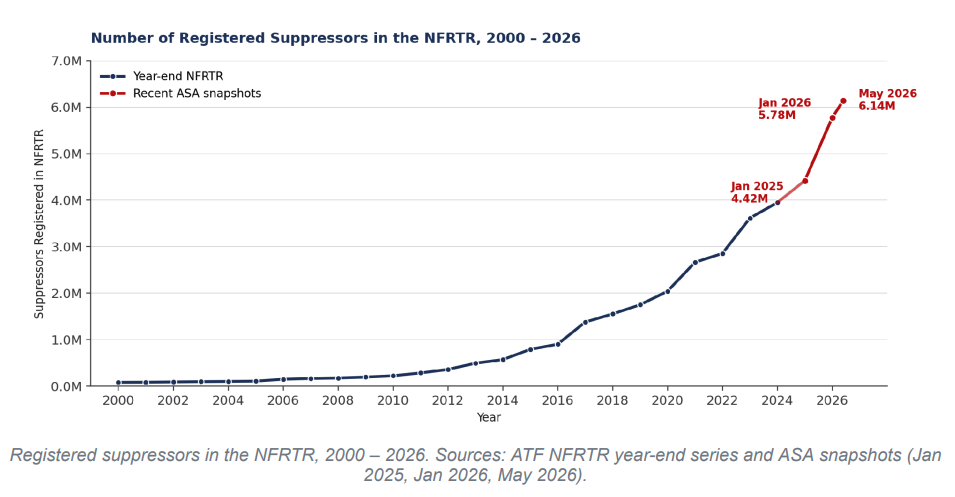
The manufacturing picture underscores the scale of that growth. In 2000, U.S. manufacturers produced just 5,001 suppressors, accounting for 6.3% of all NFA firearm manufacturing. Today, suppressors represent more than 80% of all NFA firearms manufactured annually — a 271-fold increase over the past twenty-five years.
What ASA is watching
-
Litigation. ASA is leading a coalition in three lawsuits to remove suppressors and short-barreled firearms from the NFA. If successful, the suppressor and short-barreled firearm industries will be able to operate without the draconian NFA requirements for the first time since 1934.
-
ASA is also leading the charge on two challenges to state bans on civilian suppressor ownership. If successful, these lawsuits will lead to the legalization of suppressors in all 50 states, creating entirely new markets in the eight states where they are currently prohibited. On June 18, 2026, the Fifth Circuit issued a ruling in US v. Comeaux recognizing that suppressors are, in fact, bearable arms, thus deserving the full protections of the Second Amendment. This decision created a circuit split between the Fifth and Ninth Circuits, a major step towards advancing our cause to the Supreme Court.
-
ATF regulatory actions. ASA provided input on ATF’s historic package of reforms announced by the Bureau on April 29th, which included several proposed rule changes affecting suppressor buyers – the potential for joint spousal registrations, the removal of the CLEO notification requirements, and interstate transfer reporting requirements for NFA items.
-
Q4 seasonality. A typical fourth-quarter lift of 20–30% would build on top of OBBB-driven demand.
Figures sourced from ATF NFA Division monthly data, ATF FOIA Request 2026-01285 (response dated May 22, 2026), and ASA estimates.